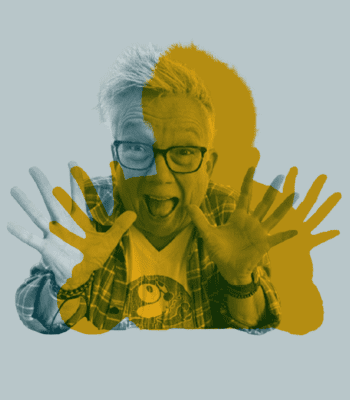
Tina has been leading her own design firm since 1976 and is the community face of Uptown Studios. She brings a wealth of experience to every project, offering a big picture perspective to each campaign. Tina’s work with non-profits has made her a pillar within the Sacramento community, regularly attending events, workshops and performing in-person outreach. It was her vision that created Uptown Studios, and made it what it is today. On the day to day, Tina is living her best life out in the world, capitalizing on her charisma and extroverted personality to bring in clients, enhance visions, and add her own unique spark to Uptown’s name and brand.
50 Years in Design: A Creative Life in Six Acts
By Tina Reynolds, President & Founder, Uptown Studios
1976–1985 — Wax, X-Acto Knives, and the Smell of Ambition
There’s a particular smell that defined my early career in graphic design, and it wasn’t the fresh scent of inspiration. It was hot wax. Specifically, the warm, slightly sweet aroma of the Letraset wax roller — the magical glue-adjacent substance that held typeset galleys onto paste-up boards. If you know, you know. If you don’t, just imagine doing a giant jigsaw puzzle while wearing oven mitts, and that’s close.
In 1976, “desktop publishing” meant you literally worked on a desktop — an actual desk — with an actual X-Acto knife, a T-square, a proportion wheel, and a blue non-photo pencil that your boss swore was invisible to the camera. (It mostly was. Mostly.) Type was set by a typesetter, delivered as long strips of photographic paper, and you cut it apart with scissors. Then you waxed the back, slapped it on your board, and burnished it down with a little bone tool like some kind of artisan bookbinder from the 1400s.
Meanwhile, America was recovering from Watergate, disco was in full swing, and the word “logo” meant something a real person drew by hand with a ruling pen and India ink. Computers? Those were for NASA. The closest thing we had to digital design was a PMT camera the size of a refrigerator that could photostatically enlarge or reduce your artwork. We called them “stats.” We loved stats the way people today love a new app.
The real magic of those years wasn’t the tools — it was the craft. You had to really know your stuff: typography rules, color theory, grid systems. There were no undo buttons. No layers. No “Command-Z.” If you slipped with the X-Acto and sliced your headline in half, you either called the typesetter for a rerun or you got very creative with rubber cement. The work was slow, tactile, and deeply satisfying — like cooking from scratch every single day.
1986–1995 — The Mac Arrives and Everything Goes Wonderfully Wrong
I will never forget the first time I sat down in front of a Macintosh. The year was 1986, the screen was roughly the size of a paperback novel, and the entire design industry was standing at a cliff’s edge debating whether to jump. I jumped. I have been in freefall ever since, and it is magnificent.
The Mac changed everything — and not all at once, which was the truly humbling part. The early versions of Aldus PageMaker and MacPaint were extraordinary in theory. In practice, printing a single-page newsletter could take forty-five minutes and required a prayer circle. Fonts would disappear mid-job. Artwork would shift mysteriously between your screen and the output. Printers would simply refuse to cooperate, the way a cat refuses to come when called. You’d submit a file to the service bureau, they’d call you back two hours later to say it had “gone PostScript,” which was their delicate way of saying your file was dead.
But the speed of change was intoxicating. Every six months, something new. Illustrator. Photoshop. QuarkXPress. The profession that had required years of apprenticeship in paste-up and typesetting was suddenly — controversially — accessible to anyone with a Mac and a copy of Helvetica. Established designers were furious. I was thrilled. The tools were democratizing, and that felt right.
Society was shifting too. AIDS activism, environmental movements, and multicultural voices were demanding new kinds of visual communication — not just advertising, but advocacy. Design wasn’t just for selling soap anymore. It could change minds. Move people. That idea planted a seed in me that was about to grow into something I’d name Uptown Studios.
1990–1999 — Uptown Studios Opens Its Doors (and Someone Immediately Asks for a Fax)
In 1992, I founded Uptown Studios in Sacramento with a conviction, a Macintosh IIci, and a genuinely alarming amount of optimism. The conviction was this: design should serve people, not just products. Sacramento had nonprofits, community organizations, and government agencies doing incredible work — work that was invisible because nobody was helping them tell their story. I wanted to fix that. I also wanted to stop working for agencies that only cared about beer accounts, but let’s keep the focus aspirational.
“Social marketing” — the use of marketing strategies for social good — was not exactly a household term in 1992. When I explained what Uptown Studios did, I got a lot of politely confused nods. But the work spoke for itself. We did public health campaigns, environmental awareness, voter outreach, arts organizations, foster care advocacy. The clients were mission-driven and passionate, and honestly they were a lot more fun at holiday parties than the car dealership people.
The nineties were also the decade the internet arrived and made everyone lose their minds in the best possible way. Suddenly we were building websites — actual websites — in Dreamweaver and hand-coding HTML with the slightly dazed confidence of people assembling furniture without instructions. “Under Construction” GIFs were considered professional. We used them unironically. The web was the Wild West, and we were absolutely here for it.
By the end of the decade, we had a real client roster, a small but fierce team, and a reputation in Sacramento as the agency that actually gave a damn about your mission. Cell phones were now a thing, email was replacing faxes (RIP, faxes — you smelled terrible), and I had begun to suspect that this internet situation was not going away.
2000–2009 — Y2K Didn’t Kill Us, But Flash Almost Did
On the night of December 31, 1999, I was at a party, champagne glass raised, fully prepared for civilization to collapse because all the computers would forget what year it was. Nothing happened. Uptown Studios survived Y2K without incident. We were less lucky with Flash.
Oh, Flash. You beautiful, browser-crashing, plugin-requiring nightmare. In the early 2000s, Flash websites were considered the pinnacle of design sophistication. Animated intros with dramatic music! Rollover effects! Cursors that turned into little sparkles! Clients wanted all of it. We delivered all of it. And then we spent the next decade quietly helping those same clients migrate away from all of it, because Flash was a disaster waiting to happen and also Steve Jobs was coming for it.
The 2000s were when social media crept in the back door like a teenager coming home after curfew. First Friendster, then MySpace, then — in 2006 — Facebook, which arrived and slowly ate everything. For marketing and communications professionals, this was both thrilling and slightly terrifying. We were no longer just managing one-way broadcast messages. Now audiences talked back. In public. Loudly. The organizations we worked with — nonprofits, government agencies, advocacy groups — suddenly needed a whole new skill set, and so did we.
Meanwhile, Bush, 9/11, Katrina, and the 2008 financial crisis reminded everyone that the real world had a habit of interrupting our screen time. The mission-driven work we did felt more urgent than ever. Voter registration. Public health messaging. Environmental advocacy. Social marketing wasn’t a niche anymore — it was essential infrastructure for a democracy trying to hold itself together.
2010–2019 — Everything Goes Mobile and I Finally Stop Printing MapQuest Directions
The moment I realized the world had permanently changed was when a client asked me to “make the website work on my phone.” It was 2011. I nodded calmly, returned to the office, and we all had a small collective panic. Responsive design was not yet intuitive. It was, in fact, a philosophical crisis disguised as a coding problem. We figured it out. We always figure it out.
The 2010s were the decade everything became a screen and every screen became a platform. Instagram launched in 2010 and promptly rewired how humans process visual information. Suddenly everyone had opinions about typography, composition, and color palettes — they just called it “aesthetics” — and they were right! That’s what those things are! It was democratizing in exactly the same way the Mac had been in 1986, and I had exactly the same reaction: thrilled, a little territorial, ultimately enthusiastic.
For Uptown Studios, this decade was about expanding the definition of “creative agency.” Video production. Social media strategy. ADA accessibility. SEO. We weren’t just making things look good anymore — we were helping organizations be found, be heard, be understood across a proliferating landscape of channels and devices. Our nonprofit and government clients needed partners who could navigate this complexity without losing the mission-driven heart of the work. That was us. That has always been us.
Personally, this was also the decade I got really, really good at explaining to clients why their nephew who “does websites” was not an adequate substitute for a professional agency. I developed a very patient tone of voice for this conversation. I have used it many times.
2020–2026 — A Pandemic, an AI Revolution, and Fifty Years of Not Stopping
2020 arrived like a plot twist nobody saw coming, which in retrospect says something about all of us. The world went remote, clients went remote, Uptown Studios went remote, and I found myself running a Sacramento creative agency entirely from my laptop, on Zoom, while learning what a “mute button” was in real time. We survived. We adapted. We made a lot of things work that we didn’t think would work, and somewhere in there we also made some of the most meaningful work of our careers — public health communications, election outreach, community resilience messaging — because that’s what you do when the stakes are real.
And then AI walked into the room. I want to be honest about this: when generative AI tools started appearing in 2022 and exploded in 2023, I paid close attention. I am fifty years into this work. I have seen the arrival of the Mac, the internet, mobile, social media — every single wave of technology that people said would “replace designers.” None of them did. What they did was change what designers do and, frankly, make it more interesting. AI is the same. It’s a collaborator. A very fast, occasionally overconfident collaborator who sometimes invents facts, but a collaborator nonetheless.
What fifty years in this work has taught me is this: the tools change constantly, but the human need for clarity, beauty, and connection does not. People need to understand complicated things. They need to feel moved by a well-told story. They need their organizations to look credible and sound trustworthy. No algorithm fixes that — a thoughtful human with great tools does.
In 2026, Uptown Studios is still here. Still Sacramento. Still woman-owned. Still mission-driven after thirty-plus years. I’m growing vegetables in six raised garden beds, learning pickleball, planning a trip to Portugal, and genuinely excited about what comes next. If the last fifty years are any indication, it’s going to be weird, wonderful, and nothing at all like what I expect.
And I cannot wait.
Tina Reynolds is the President and Founder of Uptown Studios, Inc., a Sacramento-based creative, marketing, and communications agency serving nonprofits, government agencies, and mission-driven organizations since 1992. uptownstudios.net